

(Updated 6/2/2026)
In today’s rapidly evolving digital landscape, a fragmented approach to digital marketing no longer suffices. Business owners must adopt a holistic digital marketing strategy to stay ahead of the competition and drive better results. By integrating various digital marketing elements into a cohesive plan, businesses can optimize their efforts, create better customer experiences, and maximize their return on investment (ROI).
Why Holistic Digital Marketing Matters
A holistic digital marketing strategy ensures that all marketing efforts are aligned and work synergistically. Rather than treating SEO, social media, email marketing, advertising, and website optimization as separate initiatives, a holistic approach connects them under a unified strategy that supports business goals.
This approach helps create a consistent brand message, enhances the customer experience, and improves overall campaign effectiveness.
The Hidden Cost of Fragmented Marketing
Many businesses invest in individual marketing tactics without a clear strategy connecting them together. While each tactic may have value on its own, disconnected efforts often lead to missed opportunities and inconsistent results.
For example:
- Social media content may not support SEO goals.
- Paid advertising may drive traffic to pages that are not optimized for conversions.
- Email campaigns may not reflect customer behavior on the website.
- Valuable customer data may remain siloed across different platforms.
When marketing channels operate independently, businesses often spend more while achieving less. A holistic strategy ensures every marketing activity contributes to a larger objective, creating greater efficiency and stronger results.
Enhanced Customer Experience
Customers interact with brands through multiple touchpoints, including social media, email, websites, online reviews, digital advertising, and search engines. A holistic approach ensures a seamless and consistent experience across all channels.
When messaging, branding, and customer interactions are aligned, businesses build trust and create a more intuitive experience for potential customers. Consistency also reduces friction throughout the buyer’s journey, making it easier for customers to take the next step.
Improved ROI
By integrating various digital marketing tactics, businesses can leverage data from one channel to inform strategies in another. For example, insights from social media engagement can help refine email campaigns, while website analytics can reveal opportunities to improve advertising performance.
Rather than evaluating channels individually, a holistic approach allows businesses to understand how channels work together to generate results. This leads to more informed decisions, improved resource allocation, and a stronger return on investment.
Mapping Marketing to the Modern Customer Journey
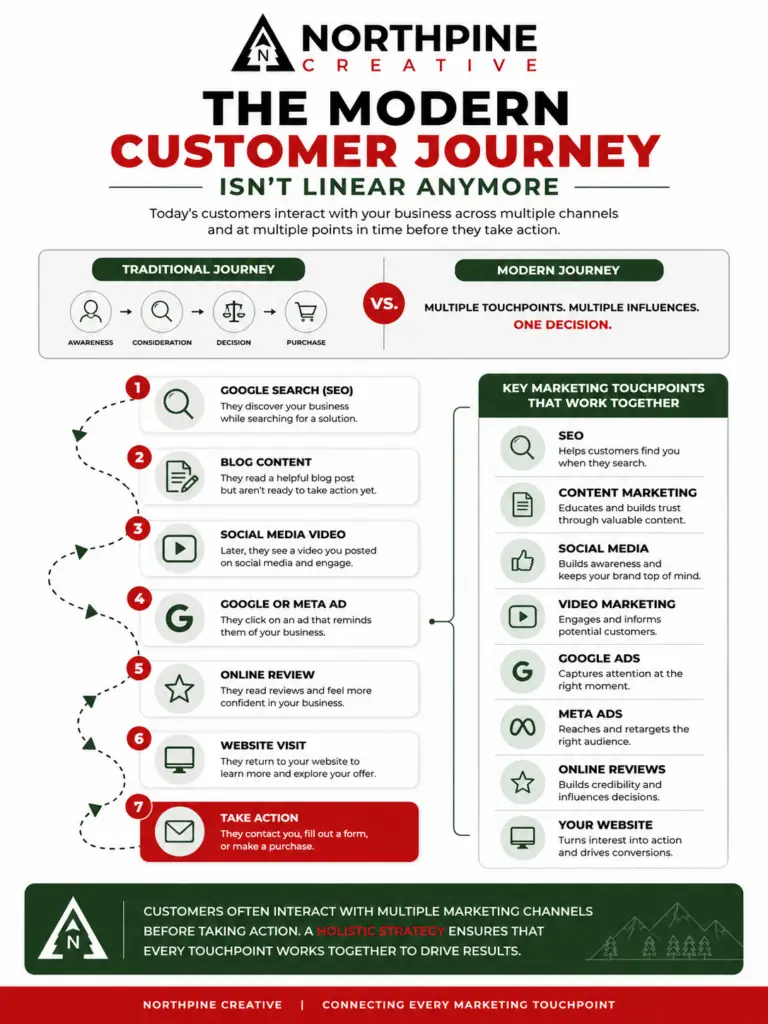
One of the most valuable aspects of a holistic marketing strategy is its ability to support customers throughout their entire journey. However, the customer journey is no longer a simple, linear path from awareness to consideration to decision.
Today, customers often interact with a business across multiple channels and at multiple points in time before taking action. Someone may first discover your business through an SEO-optimized blog post, leave without filling out a form, later see a video you posted on social media, and then finally click on a Google or Meta ad before deciding to contact you.
This is why a holistic strategy is more important now than ever. If each marketing channel is treated as a separate effort, it becomes harder to create a consistent experience, understand what is influencing customer decisions, and move people toward conversion.
A holistic approach ensures that every touchpoint works together. Your website, search visibility, social media content, digital ads, email marketing, and online reviews all contribute to the larger customer experience.
Awareness
At this stage, potential customers are identifying a problem, need, or opportunity. They may not be ready to contact a business yet, but they are beginning to gather information.
- Search Engine Optimization (SEO)
- Educational blog content
- Social media content
- Video marketing
- Digital advertising
Consideration
Prospects begin researching solutions, comparing providers, and looking for signals of trust. They may return to your website multiple times, engage with social content, read reviews, or click on retargeting ads before making a decision.
- Email marketing
- Downloadable resources
- Educational videos
- Retargeting campaigns
- Reviews and testimonials
Decision
Potential customers are ready to take action, but the final conversion may be influenced by several previous touchpoints. A clear website, strong calls-to-action, consistent messaging, and trust-building content all play an important role.
- Service pages optimized for conversions
- Case studies
- Testimonials
- Online reviews
- Google Ads and Meta Ads
- Clear contact forms and calls-to-action
Retention
After becoming a customer, continued engagement helps strengthen relationships and encourage repeat business.
- Customer newsletters
- Ongoing communication
- Loyalty programs
- Personalized recommendations
- Social media engagement
Advocacy
Satisfied customers can become some of a company’s most effective marketing assets. Their reviews, referrals, and shared experiences can help influence new customers who are still moving through their own decision-making journey.
- Referral programs
- Customer success stories
- Community engagement
- Review generation strategies
- Social proof across marketing channels
Because customer journeys are more complex and multi-touch than ever before, businesses need a strategy that connects every part of their digital presence. When each channel supports the others, marketing becomes more consistent, measurable, and effective.
Key Components of a Holistic Digital Marketing Strategy
Integrated SEO and Content Marketing
Combining SEO and content marketing ensures that content is not only valuable to the audience but also optimized for search engines. This dual approach can significantly increase organic visibility, website traffic, and lead generation.
Content should be developed with both user intent and search performance in mind, helping businesses attract the right audience while establishing authority within their industry.
Unified Social Media Strategy
A cohesive social media strategy aligns messaging across platforms, increasing brand visibility and engagement.
Rather than posting content in isolation, social media should support broader business objectives such as brand awareness, lead generation, website traffic, and customer retention.
Consistency is especially important as customers often interact with social media content multiple times before taking action. Every post should contribute to the larger story your brand is telling.
Comprehensive Analytics and Attribution
Data is what connects the entire marketing ecosystem.
Businesses that utilize tools such as Google Analytics, Google Search Console, CRM platforms, and marketing automation systems gain valuable insight into customer behavior and campaign performance.
A connected analytics strategy helps answer important questions:
- Which blog posts generate leads?
- Which advertising campaigns drive qualified traffic?
- Which channels produce the highest-value customers?
- Where are users dropping off during the buying process?
- Which touchpoints are contributing to conversions?
These insights enable continuous improvement and more informed marketing decisions.
Cross-Channel Campaigns
Running campaigns across multiple channels—including email, social media, PPC advertising, and organic search—helps reinforce messaging and expand reach.
A holistic strategy ensures these efforts work together rather than competing for attention. When channels support one another, businesses create more touchpoints and increase the likelihood of conversion.
Your Website Is the Hub of Your Marketing Ecosystem
Many businesses view their website as an online brochure. In reality, it serves as the foundation of nearly every digital marketing effort.
Whether someone discovers your business through:
- Google Search
- Social Media
- Digital Advertising
- Email Marketing
- Online Reviews
They will likely visit your website before making a decision.
A website should do more than provide information. It should actively support business growth by:
- Generating leads
- Providing clear calls-to-action
- Delivering a consistent brand experience
- Capturing valuable customer data
- Integrating with marketing and automation tools
Without a strong website foundation, even the most effective marketing campaigns can struggle to produce meaningful results. Marketing can drive visitors to your website, but your website ultimately determines whether those visitors become customers.
A Real-World Example of Holistic Marketing
Imagine a local service business launching a new service offering.
A fragmented approach may involve creating a few social media posts and running a Google Ad campaign.
A holistic approach would include:
- Building an SEO-optimized service page
- Publishing educational blog content
- Running Google Ads and Meta Ads
- Creating email campaigns for existing customers
- Producing supporting social media content
- Encouraging reviews from satisfied customers
- Tracking performance data across all channels
A prospective customer may first discover the business through a Google search, revisit after seeing a social media video, and finally convert after clicking on a retargeting advertisement. Every touchpoint contributes to the final decision.
When these efforts work together, businesses create a more cohesive customer experience and increase the effectiveness of every marketing dollar spent.
Looking Ahead: The Future of Holistic Marketing
As digital marketing continues to evolve, businesses must adapt to changing consumer expectations and emerging technologies.
- AI-powered personalization
- Marketing automation
- Predictive analytics
- First-party data strategies
- Conversational marketing
- Enhanced local search optimization
Organizations that successfully integrate these technologies into a broader marketing strategy will be better positioned to create meaningful customer experiences and maintain a competitive advantage.
How Northpine Creative Can Help
At Northpine Creative, we believe successful marketing is about more than individual tactics. It is about creating a strategy where every channel works together to support your business goals.
Our team helps businesses develop and implement holistic digital marketing strategies that connect website performance, SEO, content marketing, social media, digital advertising, and analytics into one cohesive plan.
By aligning your marketing efforts around a shared strategy, we help create clarity, improve performance, and build a stronger foundation for long-term growth.
Conclusion
Adopting a holistic digital marketing strategy is no longer optional—it is essential for businesses looking to thrive in an increasingly competitive digital landscape.
Before investing in another marketing tactic, ask yourself:
- Is it aligned with our business goals?
- Does it support the customer journey?
- Is it connected to our existing marketing efforts?
- Can we measure its impact?
The most successful businesses are not necessarily doing more marketing. They are ensuring every marketing effort works together toward a common objective.
By integrating digital marketing channels into a unified strategy, businesses can create better customer experiences, improve ROI, and position themselves for sustainable growth in the years ahead.